
Reviewed · CASTLE DISTRICT WALKS & TICKETS
Buda Castle Walking Tour: A Kingdom of Many Nations
Castle Hill tells a thousand-year story in one walk. This small-group Buda Castle District walk is the best way to connect the dots between palaces, churches, and the people who ruled here before you head for the views. You’ll tour the UNESCO-listed area with a guide who keeps the story clear, not academic.
I love the tight group size, max six, because questions actually get answered. I also love how the tour explains the changing purpose of the buildings, so Matthias Church and the palace do not feel like random stops.
One possible drawback: the big ticket moments inside and up on the hill can cost extra. You’ll have to budget for Matthias Church and Fisherman’s Bastion entrances, and Buda Castle access may also involve fees depending on what you want to see.
In This Review
- Key highlights worth showing up for
- Why Castle Hill is more than a castle district
- The small-group feel that makes the stories stick
- Stop 1: Opening views at the Buda Castle complex
- Stop 2: The palace that kept changing jobs
- Stop 3: Sándor Palace, Hungary’s presidential residence
- Stop 4: Matthias Church, the interior worth the ticket
- Stop 5: Fisherman’s Bastion, the view with meaning
- Stop 6: Vienna Gate and the Roman tease toward Aquincum
- Price and value: is 126.15 a good deal?
- The guides you might get, and why their style matters
- What you’ll walk away with
- Who this tour fits best
- Should you book this Buda Castle walking tour?
- FAQ
- What is the price for the tour?
- How long is the Buda Castle walking tour?
- How big is the group?
- Is the tour offered in English?
- Where does the tour start and end?
- What is included in the price?
- Which tickets are not included?
- Is hotel pickup included?
- Can I cancel for a full refund?
Key highlights worth showing up for

- Small-group size (max six) keeps the walk personal, not a noisy shuffle
- Matthias Church focus includes the iconic roof and a chance to go inside with a ticket
- Fisherman’s Bastion viewpoints give Danube and city panoramas, plus symbolism in the architecture
- A building-focused history lesson explains how rulers and uses changed over centuries
- Local-guide storytelling examples include guides like Peter, Kata, Veronica, and Marianna who make the sites feel lived-in
- End at Vienna Gate for long views toward Obuda and Aquincum
Why Castle Hill is more than a castle district
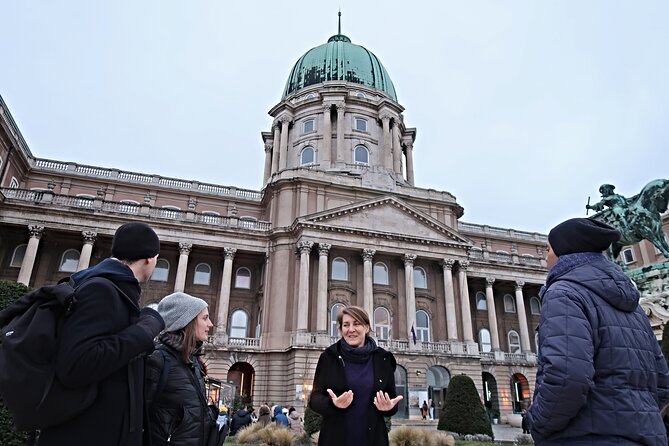
Castle Hill can trick you. From street level, it looks like you’re surrounded by palaces and churches, but what you’re really seeing is an old neighborhood that kept getting rebuilt. The cobbled streets, narrow lanes, and mixed facades make it feel like history you can walk through, not history locked behind glass.
This walk is built for that. You start where power once sat, then you work outward toward the religious landmark and the viewpoint terraces. The guide helps you read the place as layers, from medieval to Ottoman to Habsburg, and then into the modern cityscape after major 20th-century destruction.
The small-group feel that makes the stories stick
The headliner here is the group size. With a maximum of six people per booking, the guide can slow down when you have questions, and speed up when you want photos. It also means you’re not stuck listening from the back while everyone else controls the pace.
In real life, that matters. In past groups, guides like Peter were able to adjust the tour to what people cared about most, and Kata matched pace while keeping the narration energetic and easy to follow. Veronica is another example of a guide who made the tour feel like a story with a thread, not a list of monuments.
You’ll also get some practical help. One guide, Judith, even helped people figure out how to move around using public transportation. If you like learning how to navigate a city, not just sightsee, this kind of guidance is a bonus.
More of Castle Hill, cobble by cobble:
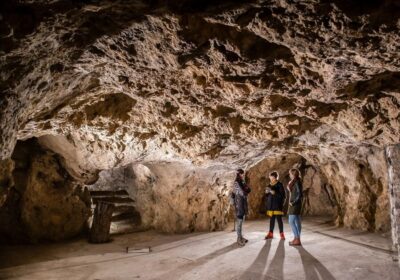
- Budapest: Buda Castle Cave Tour
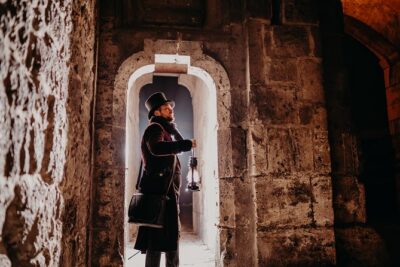
★ 4.7 · 5,677 reviews - Budapest: Buda Castle District Vampires and Myths Night Tour
★ 4.6 · 3,830 reviews - Budapest: Buda Castle Walk with Saint Stephen’s Hall
★ 4.5 · 3,012 reviews
Stop 1: Opening views at the Buda Castle complex
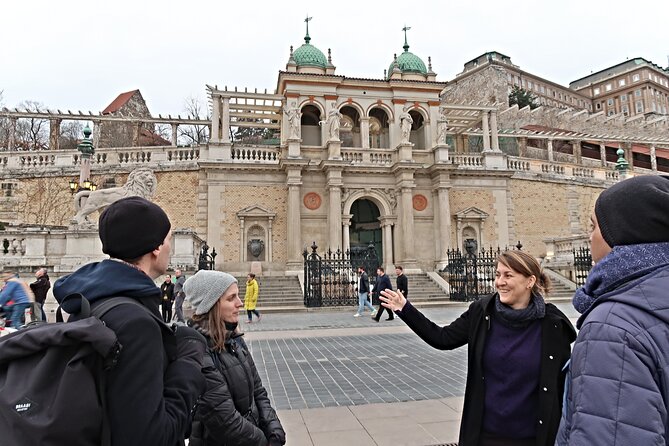
You kick things off in the Castle District with the big visual anchors. On Castle Hill’s oldest streets, two buildings visually dominate: the massive palace complex at the southern tip and Matthias Church in the center, recognizable by its colored roof and tall steeple.
This opening stretch is not just sightseeing. It’s a setup for the rest of the tour. Your guide helps you understand why these two buildings were chosen as symbols, and how their styles reflect the changing tastes and rulers of Budapest over time.
Also, expect to walk a good chunk early. One practical tip: wear shoes that can handle uneven stone. Castle Hill’s ground can feel more demanding than you expect, even if the route looks short on a map.
Stop 2: The palace that kept changing jobs
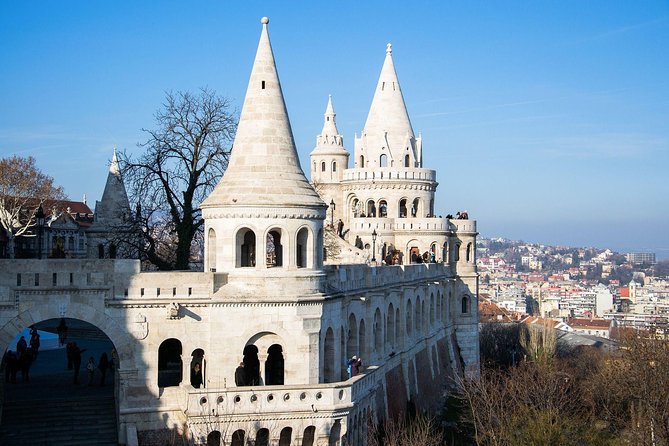
Next, the tour shifts from views to function, which is where the experience really turns into a learning walk. You’ll talk about how the palace was rebuilt, extended, altered, burned, and rebuilt again multiple times.
The guide frames the main turning points. You learn that King Béla IV erected a fortress here around 1250 after the devastation of Mongol invasions. Then, during the Renaissance era, King Matthias transformed the area into one of Europe’s most famous courts by the late 15th century.
After that, the storyline keeps rolling. Turkish pashas ruled Hungary for over 150 years, and then a succession of Hapsburg emperors took over. And after World War II, the complex gained the eclectic appearance it has today.
Why I think this is great for you: it prevents the common Budapest mistake of treating monuments like isolated photo backdrops. After you hear this building-history arc, you can look at the facades and understand why they look the way they do.
If you’re the type who loves to connect eras, pay attention to how your guide describes the palace’s role shifting between fortress, royal seat, and national symbol.
Stop 3: Sándor Palace, Hungary’s presidential residence

From the palace complex area, you move to Sándor Palace. This is the official residence of the President of Hungary and also the seat of the Office of the President, a role it has held since 2003.
You’ll also get the older architectural angle. The original palace was built in Neoclassical style in 1806, commissioned by Count Vincent Sándor, an aristocrat and philosopher within the Austro-Hungarian Empire.
This stop is brief, and that’s fine. It works like a pause in the tour rhythm. You’re still in the same Castle District “power zone,” but now you’re seeing what modern state leadership looks like in the same physical space where older empires once held court.
More of the city, bank to bank on foot:
- Big Bus Budapest Hop-On Hop-Off Bus and Walking Tour★ 3.5 · 2,206 reviews
- Budapest: Buda Castle District Walking Tour★ 4.6 · 2,108 reviews
- Budapest City Landmarks Walking Tour in 2 Hours★ 5.0 · 2,048 reviews
Stop 4: Matthias Church, the interior worth the ticket
Matthias Church is the moment a lot of people picture when they think of the district. Outside, the roof grabs your attention with its decoration, and the building’s silhouette is unmistakable.
Your guide will explain that the church you see is essentially a refined Neogothic reconstruction fantasy from the end of the 19th century. It’s not plain or subtle. The interior is where the payoff often lands, and that’s why the ticket matters here.
Entrance for Matthias Church is not included. If you decide to go in, plan for time inside, not just a quick walk-through. I recommend bringing a bit of patience too. Churches can have their own pace, with visitors moving in different directions.
What I liked about the guide approaches, based on what people shared: Kata and Katie were highlighted for making the history feel connected to everyday culture, so Matthias Church turns into a story you can understand, not just a pretty building you check off.
Stop 5: Fisherman’s Bastion, the view with meaning

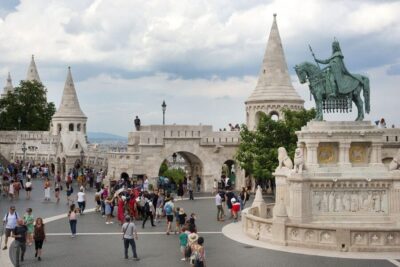
Then you reach Fisherman’s Bastion, a viewpoint spot with style and symbolism baked in. This is an architectural fantasy in neo-Gothic and neo-Romanesque styles, designed and built between 1895 and 1902.
The guide points out one of the neatest details: the seven towers represent the seven Magyar tribes that settled in the Carpathian Basin at the end of the 9th century. So while yes, it’s a photo stop, it’s also a monument to the founding narrative Hungary tells about itself.
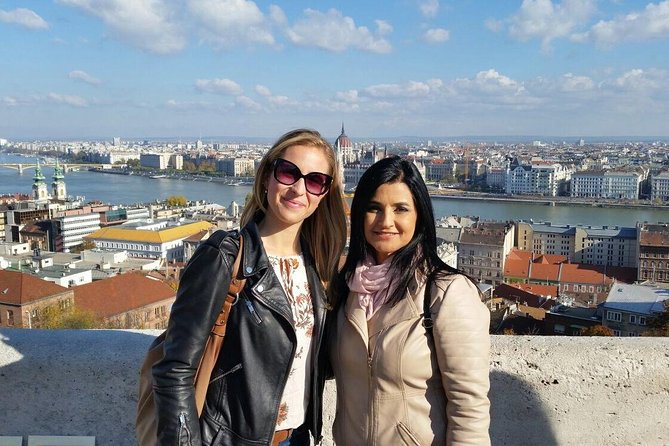
From the terrace, you get one of Budapest’s best panoramic views. On a clear day, you can see the Danube, Margaret Island, Pest, and Gellért Hill.
Entrance here is not included, so you’re paying extra if you want to access the areas that make the viewpoint possible. If you’re trying to keep the cost low, you’ll still see plenty from outside, but the full experience generally comes with the ticket.
Practical note: this is a walking tour, but Fisherman’s Bastion is one of those “look around slowly” spots. Give yourself a couple of minutes to actually take in the river view, then circle back for photos.
Stop 6: Vienna Gate and the Roman tease toward Aquincum

The tour ends at Vienna Gate. It’s a great final choice because it pulls your gaze outward. From here, you can see all the way toward Obuda, where the Romans founded the city called Aquincum.
So you finish with a long-range perspective, not just another building close-up. It’s a smart ending because it reminds you that Budapest is layered. Romans, medieval kings, Ottoman rule, Habsburg politics, and modern Hungary all fit into the same hill and river geography.
If you like planning your day, this ending also works well. You can keep exploring downhill on your own, or use the view as a mental map before you cross the river or head into Pest.
Price and value: is 126.15 a good deal?
At $126.15 per person for about three hours, the cost can feel like a lot at first glance. But you’re paying for three things at once: a pro guide, a small group size, and a structured route that covers the highest-impact sights on Castle Hill.
Here’s where the value becomes clear. Castle District is large, and it can be easy to spend time going in circles if you’re self-guiding. This tour gives you a clear order, and more importantly, it gives you a narrative thread so you understand why each stop matters.
Also, tickets are not included for Matthias Church and Fisherman’s Bastion, and Buda Castle access may involve entrance fees depending on what you want to see. That means your actual all-in price will rise if you go inside everything.
Still, I think this tour is often worth it if:
- you want the highlights in a half-day window
- you care about how rulers and building uses changed
- you appreciate small-group pacing over big group lines
If you’re on a strict budget or you only want exterior photos, you might prefer a self-guided route. But if you want the story tied to the stone, a guided walk is a strong use of your time.
The guides you might get, and why their style matters
The guide quality shows up again and again in the feedback names. Gergely (Gregory) was praised for being deeply familiar with the castle area and Budapest history, and for tailoring the route to what people wanted. Another highlight: Marianna was noted for explaining the 1,000+ year arc of Hungary in an entertaining way, and also for sharing personal context about living under Soviet occupation.
Runa was praised for friendly guidance and for providing helpful context. Henk was highlighted for being very informative. Veronica was singled out for turning what could have been a dry walk into a connected history lesson.
Even Peter shows up in praise for adapting the walk for the group size and interests. And Judith is the standout example of a guide who helped with practical city movement, like public transportation planning.
You don’t control which guide you get, but these examples are a useful clue. This isn’t just a “show you the sights” situation. The most praised part is the way the guide makes the history feel human and understandable.
What you’ll walk away with
By the end, you should feel like you understand Budapest from the top down. You’ll connect the palace to the fortress era, the Renaissance court, the long Ottoman period, and the Habsburg succession. You’ll also understand why Matthias Church and Fisherman’s Bastion are more than pretty backdrops, including the timing and design logic of each.
And because the walk ends at Vienna Gate, you’ll have a built-in mental map for where to go next. Obuda and Aquincum are now part of your “what am I looking at” conversation, not just a random place name on a sign.
Who this tour fits best
This is a smart pick if you:
- are visiting Budapest for the first time and want high-impact Castle Hill coverage
- enjoy history, but want it explained through real buildings and visible changes
- prefer small groups, where you can ask questions
- want a guide to help you move through tricky areas efficiently
It may be less ideal if you:
- only want museum-style time inside large buildings
- strongly dislike paying for separate entrances
- have very limited walking tolerance, since Castle Hill’s streets are narrow and cobbled
Should you book this Buda Castle walking tour?
I’d book it if you want a focused Castle Hill experience with context built in. The tour’s best value is the way it connects sites through the palace’s repeated transformation and through the stories behind Matthias Church and Fisherman’s Bastion.
I’d think twice if you already have a strong plan to spend most of your time inside specific buildings, because tickets are extra and the tour time is structured as a walk with stops, not a museum crawl.
One good scheduling trick: try to get your bearings around the city first, then treat this tour as the “insider” top-of-the-hill view. When you do it later in the day, Vienna Gate’s Roman-to-modern viewpoint can feel especially satisfying.
FAQ
What is the price for the tour?
The tour costs $126.15 per person.
How long is the Buda Castle walking tour?
It lasts about 3 hours.
How big is the group?
It is a small-group tour with a maximum of 6 people per booking (and up to 8 travelers for the activity overall).
Is the tour offered in English?
Yes, it is offered in English.
Where does the tour start and end?
It starts at Budapest, Országház u. 31, 1014 Hungary and ends in Budapest (the end point is listed as Budapest, Hungary).
What is included in the price?
A 3-hour guided walk and a professional guide are included.
Which tickets are not included?
Entrance fees are at your own expense. Tickets are not included for Buda Castle, Matthias Church, and Fisherman’s Bastion.
Is hotel pickup included?
No, hotel pickup and drop-off are not included.
Can I cancel for a full refund?
Yes. You can cancel up to 24 hours in advance for a full refund.
The newest crossings added in Budapest






Castle District Walks & Tickets, compared.

Buda Castle District Vampires and Myths Night Tour
Read our review →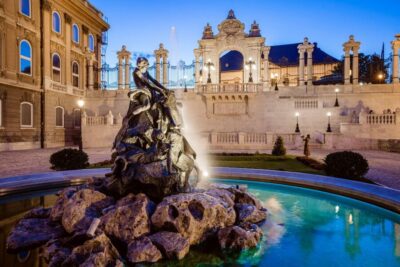
Buda Castle District Dark History, Legends and Vampire Night Tour
Read our review →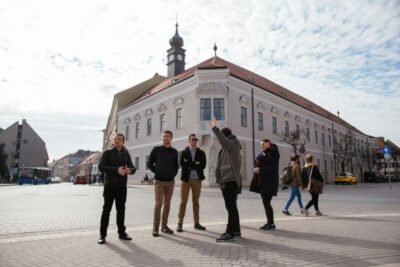
Buda Castle District Walking Tour with a Historian
Read our review →

Walking tour in the Buda Castle incl. Fisherman’s Bastion
Read our review →Browse the lists this tour appears in