
Power has a home in Budapest. This private walking tour around the Buda Castle District turns big, heavy topics like kings, sieges, and revolutions into clear street level stories. I love the way Peter Guba, a political scientist and local historian, explains the politics and power behind the stones, not just the dates. I also like that it’s fully private and can be tailored to your pace and interests, with stops beyond the usual photo lines, like hidden courtyards and offbeat corners. One drawback to consider: entrance fees are not included, so if you want to go into everything, expect extra costs on top.
You’ll cover major Castle sights like Matthias Church and Fisherman’s Bastion, then pause for viewpoints and context that makes the whole area easier to understand. The tour runs about 3 hours, includes time for questions, and even comes with coffee or tea along the way. If you want an extra vertical accent, you might add the tower of Mary Madeleine, depending on your interests and timing. Start point is easy: in front of Baltazar Restaurant, by Kapisztrán Square.
In This Review
- Key Points That Make This Tour Different
- Why Buda Castle Politics Matter on a Walking Tour
- Finding the Starting Line at Kapisztrán Square
- Matthias Church: Faith, Style, and Who Needed Whom
- Fisherman’s Bastion Viewpoints and the City Below
- Inside the Buda Castle Zone: From Medieval Fortress to Royal Palace
- Hidden Courtyards and Offbeat Corners Most Tours Skip
- Budapest History Museum: Economy, Public Affairs, and Cultural Identity
- Mary Madeleine Tower: Optional Skyline and Extra Perspective
- How Customization Works With a Guide Who Thinks Politically
- Price and Value: $212 Per Group Up to 4
- What to Bring and How to Get the Most From the Walk
- Should You Book This Buda Castle Private Walking Tour?
- FAQ
- How long is the Buda Castle private walking tour?
- What is the price for this tour?
- Where do we meet the guide?
- What’s included in the tour price?
- What is not included?
- Is the tour private?
- What languages are available?
- Can the itinerary be customized?
- What should I bring?
- What are the cancellation and payment options?
Key Points That Make This Tour Different
- Peter Guba’s political science angle connects Hungarian history to how power actually worked
- Private and customizable pacing, route, and themes, so it fits your curiosity
- Hidden courtyards and quiet viewpoints beyond the standard checklist
- Iconic stops with context, including Matthias Church and Fisherman’s Bastion
- Coffee or tea included, so it feels like a real guided walk, not a rushed conveyor belt
- Optional tower of Mary Madeleine if you want to add a sharper skyline moment
Why Buda Castle Politics Matter on a Walking Tour
Most Budapest tours treat the Castle District like a set of landmarks. This one treats it like a power map. Your guide is not only a local historian, but also a political scientist, so you get explanations that link architecture and public spaces to ambition, alliances, conflict, and identity.
That matters because Buda Castle is not one simple story. It’s a medieval fortress that later became a baroque royal palace, and both layers keep showing up in the way people built, rebuilt, governed, and survived. During the walk, you’ll hear about kings and queens, sieges, political intrigue, and everyday life around the fortress, not just royal pageantry.
I like tours that help you read a city. Here, you’ll start noticing patterns: where authority was displayed, where defense shaped movement, and how culture was used to communicate legitimacy. If you’ve ever wondered why the Castle District feels both grand and tense, this tour gives you the missing context.
Finding the Starting Line at Kapisztrán Square
You’ll meet the guide in front of Baltazar Restaurant, by Kapisztrán Square. This is a good practical choice because it’s central to the Castle area approach, and it helps you start with momentum instead of doing a long pre-tour transit.
From this start, you’ll walk into the Castle District’s street layout, cobblestones, and shifting viewpoints. That walking part is key. You’re not just seeing from one angle. You’re moving through the district, which is the only way to grasp how elevations and sightlines shaped how people defended territory and controlled access.
One small consideration: wear comfortable shoes. The tour is a walking experience focused on courtyards, corners, and viewpoints, so you’ll want good grip and support from the start.
More of Castle Hill, cobble by cobble:
- Budapest: Buda Castle Cave Tour
★ 4.7 · 5,677 reviews - Budapest: Buda Castle District Vampires and Myths Night Tour
★ 4.6 · 3,830 reviews - Budapest: Buda Castle Walk with Saint Stephen’s Hall
★ 4.5 · 3,012 reviews
Matthias Church: Faith, Style, and Who Needed Whom
Matthias Church is one of those places you can photograph fast, and then forget. The difference here is what you learn while you’re standing there. Your guide frames it as part of how Hungary projected power through culture and religion, and how political change could show up in the built environment.
You’ll likely spend time around the church area to connect its visual appeal with the broader story of Hungarian leadership over centuries. The goal is not to bombard you with a timeline. It’s to explain why certain institutions mattered, how rulers used symbolism, and how the public experienced power in real life.
Even if you’re not a church person, this stop works because it links beauty to function. Politics has always relied on public meaning, not just armies. Matthias Church becomes a clue for reading the Castle District as an active historical stage, not a museum display.
Fisherman’s Bastion Viewpoints and the City Below
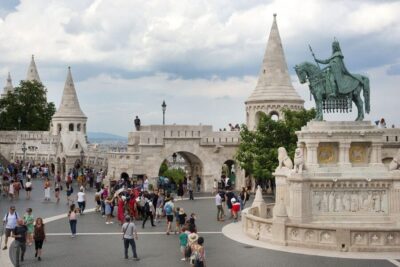
Fisherman’s Bastion is famous for a reason. The views help you understand Budapest’s geography, where the river, hills, and neighborhoods create natural lines of control. This is where the tour shifts from storytelling at ground level to a broader perspective.
Your guide will connect what you’re seeing to the long arc of Hungarian history, explaining how defense, ambition, and identity played out as the city changed. You’ll also get help reading the space: what the vantage point suggests, how the district relates to the rest of Budapest, and why viewpoints were never just for tourists.
The practical upside is that viewpoints are built-in breaks. You’ll pause, look, and ask questions while the district opens up around you. If you’re the type who likes to understand how a place works, you’ll enjoy the way the guide connects skyline moments to political history rather than leaving them as scenery.
Inside the Buda Castle Zone: From Medieval Fortress to Royal Palace
The Buda Castle itself is the big focus. The tour treats it as more than a single building. It’s presented as a medieval fortress that later became a baroque royal palace, so you get layered history walking side by side.
This is where the political scientist lens becomes especially useful. You’ll hear stories about kings and queens, conflicts, and political transformations that shaped Hungary across roughly the last 1000 years. The guide’s job is to make those transformations feel understandable, not overwhelming.
One thing I appreciate is that you don’t just get a lecture. You get explanations that connect to what you can see now: where power would have been organized, how defensive architecture influenced movement, and how rebuilding created a new message to the public.
If you care about politics more than art, this stop still delivers. If you care about architecture more than political theory, you’ll still find the stories useful because they give the buildings a job.
More of the city, bank to bank on foot:
- Big Bus Budapest Hop-On Hop-Off Bus and Walking Tour★ 3.5 · 2,206 reviews
- Budapest: Buda Castle District Walking Tour★ 4.6 · 2,108 reviews
- Budapest City Landmarks Walking Tour in 2 Hours★ 5.0 · 2,048 reviews
Hidden Courtyards and Offbeat Corners Most Tours Skip
This is where private walking tours pay off. Standard tours move like a parade. A private tour can slow down, take side streets, and land you in quieter places that don’t fit a strict schedule.
You’ll visit hidden courtyards and offbeat corners most visitors miss. Those spaces might not be the loudest on a brochure, but that’s exactly why they’re worth your time. Courtyards and smaller lanes help you understand daily life around the Castle. They also show how the district feels from a human scale perspective, not just from famous platforms.
If you like photography, these are often the best windows for real texture, shadow, and contrast. If you’re more into history, these are where the guide can explain how power and community interacted inside the fortress environment.
A consideration: these slower stops mean you should plan for steady walking. The tour works best when you’re comfortable moving at a moderate pace and paying attention for small details.
Budapest History Museum: Economy, Public Affairs, and Cultural Identity
The tour also points you toward the Budapest History Museum as a strong location for understanding Hungary’s economy, public affairs, and cultural heritage. Even if you’re not thinking of museums first, this makes sense. Politics is not only who sat where. It’s also how resources, laws, identity, and public life shaped the country.
This is one reason the tour feels more rounded than a pure architecture walk. It gives you a bridge from the Castle District’s physical authority into how power affected everyday structures. You’ll get context that helps you make sense of what you might see elsewhere in Budapest afterward.
Because entrance fees are not included, you’ll want to decide in advance how museum-heavy you want your day to be. If you’re happy with the walk and the outside views, you can still get a lot from the guide’s explanations. If you want to go deeper inside, budget extra.
Mary Madeleine Tower: Optional Skyline and Extra Perspective
You may have the option to visit the tower of Mary Madeleine. That’s a choice for people who like height, views, and the extra effort of getting a broader angle on the city.
This optional stop can be a nice way to reinforce themes you’ve already heard. Once you’ve walked the Castle District and seen the major viewpoints, adding a tower experience can help you connect geography to defense and governance again.
If you’re short on time during the rest of your trip, or if you prefer to stay focused on history sites only, you might skip it. Since the tour is customizable, your guide can adapt based on your interests and the pace you set.
How Customization Works With a Guide Who Thinks Politically
One of the biggest values is flexibility. This is a private group tour, and your route can be adapted to your needs. If you want more architecture and art, you can steer toward those details. If you want politics and power, you can put more weight on kings, wars, revolutions, and political transformations.
Your guide also encourages questions and discussion throughout. That’s not a small detail. In a Castle District walk, questions are how you connect the facts to your personal interests. Want help understanding how Hungary’s identity formed under changing regimes? Ask. Interested in how buildings and public spaces signal authority? Ask. Curious about modern Hungary and how the past echoes forward? Ask.
Because it’s private, the pace can match you. The tour can also be divided into two parts or adjusted for scheduling. That’s useful if you’re pairing this with other Budapest plans and want to avoid a full day that feels rushed.
Price and Value: $212 Per Group Up to 4
The price is $212 per group for up to four people, lasting about three hours. On paper, that sounds like a premium. In practice, it can be great value, especially if you’re traveling with friends or family who share your interest in history and politics.
Here’s how the math works out: if you fill the group with four people, the cost is about $53 per person for a private guide. Even with two people, it becomes about $106 each. Compared to fixed group tours, the value rises quickly when you can spread the cost and you care about getting real explanation time rather than standing in a crowd.
Also, the tour includes coffee or tea, and you get a specialist guide with a political science and local historian background. That combination is hard to replicate with a standard audio guide.
The main reason it might not feel like a bargain is if you’re traveling solo and prefer to see everything inside museum spaces. Entrance fees are not included, so the total trip cost can climb depending on your choices.
What to Bring and How to Get the Most From the Walk
This tour is not about comfort luxuries. It’s about moving through the Castle District with attention. Bring comfortable shoes, water, and a camera. That sounds obvious, but it matters here because the best stories happen while you’re close to details, not from far away.
If you’re sensitive to steep areas or uneven cobblestones, plan for extra time and a slower pace. Since you can customize the route and pace, you’re not forced into a single speed.
Also, come with at least one theme in mind if you can. Examples: power and succession, revolutions, how culture and religion supported authority, or how the Castle District shaped everyday life. Even if you don’t know Hungarian history yet, a general focus helps your guide aim the stories at what you want.
Should You Book This Buda Castle Private Walking Tour?
Book it if you want your Budapest history to have cause and effect. This tour is built for people who like explanations that connect architecture to politics, and politics to culture and identity. It’s also a smart choice if you value a private setting where you can ask questions and shape the route, not just follow a preset script.
Skip or reconsider if you mainly want a quick sightseeing checklist with minimal talking. This experience is story driven, guided by a political scientist and local historian, and it works best when you enjoy history as a living system, not as a set of facts.
My call: if you’re planning your first or second trip to Budapest and want the Castle District to make sense beyond photos, this is a strong way to spend three hours.
FAQ
How long is the Buda Castle private walking tour?
It lasts 3 hours.
What is the price for this tour?
The price is $212 per group, up to 4 people.
Where do we meet the guide?
Meet the guide in front of Baltazar Restaurant, by Kapisztrán Square.
What’s included in the tour price?
Included are the private guided walking tour of the Buda Castle District, expert commentary by a political scientist, a flexible itinerary (customizable themes and pace), time for questions and discussion, and coffee or tea.
What is not included?
Entrance fees are not included.
Is the tour private?
Yes, it’s a private group experience.
What languages are available?
The tour guide is available in English, French, and German.
Can the itinerary be customized?
Yes. The tour can be customized and adapted to visitor needs, including a focus on history, culture, art and architecture, or politics. It can also be divided into 2 parts or adjusted for scheduling.
What should I bring?
Bring comfortable shoes, a camera, and water.
What are the cancellation and payment options?
You get free cancellation up to 24 hours in advance for a full refund, and you can reserve now and pay later.
The newest crossings added in Budapest






Castle District Walks & Tickets, compared.

Buda Castle District Vampires and Myths Night Tour
Read our review →
Buda Castle District Dark History, Legends and Vampire Night Tour
Read our review →
Buda Castle District Walking Tour with a Historian
Read our review →

Walking tour in the Buda Castle incl. Fisherman’s Bastion
Read our review →Browse the lists this tour appears in