Reviewed · PRIVATE
Private Art Nouveau Budapest Tour
Budapest has a way of turning facades into drama. On this private Art Nouveau Budapest tour, you follow the city’s most sophisticated Secession-era details, from stained glass and wavy fronts to color-roof tiles, all guided with context so you actually see what you are looking at. Art Nouveau Budapest is the star, and it stays personal because it is a private group plan.
What I like most is the architecture-focused approach. You spend time with Ödön Lechner ideas, often compared to the Hungarian Gaudí style, plus you get a built-in pause at a proper Art Nouveau café moment instead of just rushing between photos.
One drawback to keep in mind: there has been at least one reported case of a guide not showing up, with refund questions that were not immediately resolved. It is rare, but you should still confirm your meeting time and contact details the day before so you are not stuck waiting.
In This Review
- Key points to know before you go
- Budapest Art Nouveau makes more sense when someone points at it
- Where the tour starts, and why the Museum of Applied Arts is a smart first stop
- Walking sections plus a quick tram ride keeps the style connected
- Váci Street and the modern leftovers you can still spot
- Gresham Palace: a luxurious stop that changes the pace
- Liberty Square coffee at the House of Hungarian Art Nouveau
- Hungarian State Treasury and the rooftop you only appreciate up close
- Price and value: $377 per group, up to 25 people
- Guide quality and languages: what to look for when you book
- What to wear and how to make the most of the 4-hour plan
- Should you book this Art Nouveau Budapest tour?
- FAQ
- How long is the private Art Nouveau Budapest tour?
- Where does the tour meet?
- What is included in the tour price?
- What languages are available for the live guide?
- What should I bring?
- Is cancellation possible if plans change?
Key points to know before you go
- Start at the Museum of Applied Arts for the strongest Lechner entry point
- You get a coffee or soft drink plus cake in a period setting, not a random kiosk stop
- Your route can vary depending on where you start, since you can meet at your hotel
- Expect walking plus a short tram ride to connect the sights efficiently
- Liberty Square is a highlight, with a coffee break at the House of Hungarian Art Nouveau
- You get close to the State Treasury rooftop, even if it is not obvious from street level
Budapest Art Nouveau makes more sense when someone points at it
Art Nouveau in Budapest is not just decorative. It is a whole way of thinking, built fast in the early 1900s, when different European Secession currents met local ambition. During a short window of time, architects churned out masterpieces with rounded windows, bold ceramic surfaces, and those signature wavy lines that look almost alive.
The smartest part of this tour is that you are not only seeing buildings, you are learning how the style arrived and why it changed in Hungary. The tour frames it from Viennese Secession and Jugendstil ideas, through French and Belgian Art Nouveau influences, and then lands on Hungarian Art Nouveau as a national style. That context makes the details feel less random.
And yes, you will see plenty of color. But the goal is better than photos. I love how you learn to spot the same motif repeating across neighborhoods, so the city starts to feel like one big, themed exhibition with streets instead of walls.
Where the tour starts, and why the Museum of Applied Arts is a smart first stop
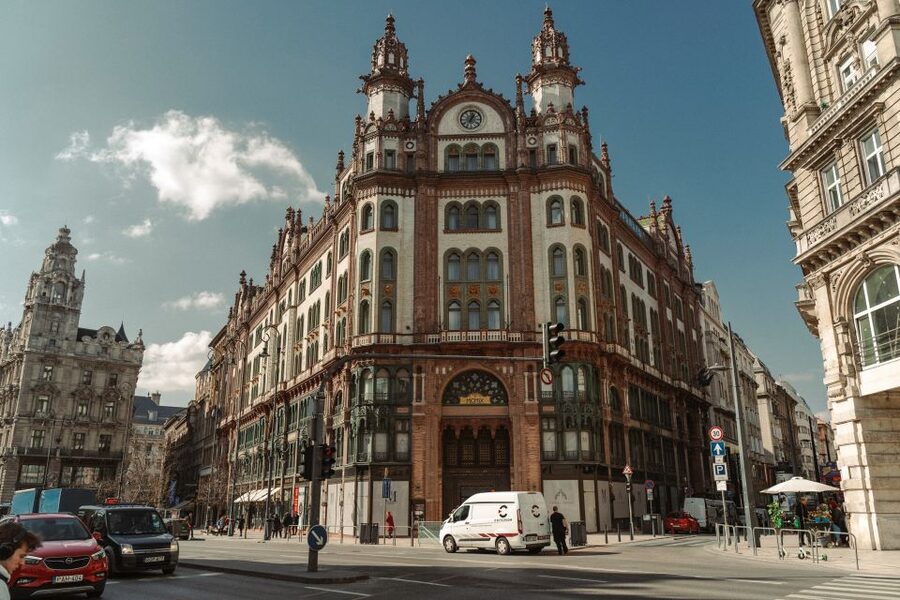
You meet your private guide at your hotel or another arranged city spot. That flexibility is great if you are staying outside the very center, or if you want to begin with an easy pickup instead of hunting a meeting point.
The tour’s best default start is the Museum of Applied Arts. It is credited as a masterpiece of Ödön Lechner, and people often nickname him as the Hungarian Gaudí, which is helpful even if it is not meant as a strict comparison. The museum is a strong opener because it lets you see how Hungarian Art Nouveau ideas can look both playful and serious at the same time.
From there, you take a pleasant walk. Walking matters here. Close up, you can notice how surfaces are uneven on purpose, how tile patterns catch light, and how window shapes and roof colors do not just decorate. They guide your eye along the facade like a visual script.
A practical note: because the route can vary with your meeting point, the order of specific stops may shift a bit. You still get the core highlights, but you might not see every building in the same sequence as someone starting from the museum area.
Still to cross in Budapest
- Budapest: City Highlights Sightseeing Cruise
★ 4.6 · 43,981 reviews - Budapest: Unlimited Prosecco, Beer and Aperol Spritz Cruise
★ 4.8 · 37,304 reviews - Budapest: Széchenyi Spa Day Ticket with Optional Upgrades
★ 4.3 · 23,911 reviews
Walking sections plus a quick tram ride keeps the style connected
Once you have soaked up a first cluster of sights, you switch gears with a short tram ride back toward the center. This is one of those choices that feels small, but it makes the whole day work.
Budapest’s Art Nouveau is spread in a way where one neighborhood view is great, but multiple neighborhoods make it click. The tram move helps you link two different concentrations of buildings without turning the tour into an endurance test.
As you travel back, you also pass through areas where you can pick out modern constructions inspired by the same Art Nouveau language. This is useful because it shows what the style looked like in its moment and what it became later. If you only visit early-1900s originals, you can miss how the city kept remixing design ideas afterward.
Váci Street and the modern leftovers you can still spot
Around Váci Street, you will see examples of modern constructions in the style. Even if the building is not from the same era, the shapes and materials often echo the original Art Nouveau vocabulary: curved details, colorful elements, and that slightly theatrical relationship between the facade and the street.
I like this part because it trains your eye. You start noticing what is truly characteristic versus what is just decorative. You also learn to look for rhythm: the way windows and ornament repeat, and how roof lines tie the whole thing together.
If you are someone who tends to scan for landmarks, this section helps you shift into slow looking. You are not just chasing famous names. You are learning how a city’s identity shows up in everyday streets.
Gresham Palace: a luxurious stop that changes the pace
At Gresham Palace, you step into a more luxurious atmosphere, the kind that makes you slow down even if you normally rush through sightseeing. The tour treats this as more than a photo break. It is a moment to feel the contrast between busy streets and a more polished, historic interior mood.
What makes this stop valuable is pacing. After you have been reading facades, you get a shift. Your brain stops comparing buildings and starts experiencing one iconic setting in a more complete way.
Depending on the exact route that day, you might also get chances to step inside special areas. The tour description emphasizes close viewing and the “more than you could ever find in a guidebook” feel, and past experiences with similar guide-led formats often include short interior moments where allowed.
Tip for your photos: since the focus is architectural, take a few minutes to shoot the facade close up first, then step back for the whole composition. With Art Nouveau, the best angles are often the ones that show both detail and overall shape.
Back across the water in Budapest:
- Budapest: Nighttime or Daytime Sightseeing Cruise★ 4.2 · 21,062 reviews
- Budapest: By Night Sightseeing Cruise with Welcome Drink★ 4.3 · 15,533 reviews
- Budapest: St. Stephen’s Basilica Entry with Options★ 4.6 · 12,322 reviews
Liberty Square coffee at the House of Hungarian Art Nouveau
Liberty Square is where the tour turns from exterior spotting into a sit-down moment with a purpose. The plan includes a coffee break at the House of Hungarian Art Nouveau, which features a private collection from the time period.
This matters because it changes the flavor of your understanding. A café stop is common on tours. A café stop tied to the style and its living context is less common.
You get coffee or a soft drink and cake, and you are doing it in a setting that supports what you just learned. The goal is to connect the building language to real life, not just architecture as an isolated museum piece.
Also, Liberty Square itself is a key reason to come. It is described as a square where the surrounding buildings are from the same period, so you can compare facades without traveling across the city. When you can see a group of siblings, it becomes easier to understand the parent design ideas.
One practical tip: if you have strong preferences, ask your guide where to stand for the best view of the details. At squares like this, angles matter, and the guide can usually point you to a spot that makes the wavy roof lines and window rhythm look extra convincing.
Hungarian State Treasury and the rooftop you only appreciate up close
The last big architectural moment is the Hungarian State Treasury. The rooftop is described as unforgettable and also invisible from street level, meaning you need to get close to appreciate it.
This is exactly why a guided route is worth it. From across the street, you can miss the most interesting part of a facade. Up close, you can see the shaping and the way the roof area ties together the rest of the building’s design logic.
The tour experience ends with you admiring that rooftop, basically training you to look at the building in full context rather than treating it like a single flat front.
If you care about design, give yourself a little patience here. Rooftops can feel like “we will get to it later,” but Art Nouveau rooftops often carry the visual punch. Take the extra minute to look from different angles. You will likely spot patterns that you did not see the first time.
Price and value: $377 per group, up to 25 people
The price is listed as $377 per group for up to 25 people, and the tour lasts 4 hours. Since it is a private group format, the value depends on your group size and how much you want a guide steering the experience.
If you are traveling as a couple or small group, you are paying for the guide’s time and the organized pacing. The included coffee and cake helps too. More importantly, an art-historian style approach is not just “show and go.” You get explanations that turn architecture into something you can recognize later while walking on your own.
If you are part of a larger group (closer to that 25-person limit), this becomes more budget-friendly because the per-person cost drops, assuming your group actually benefits from a tailored route and keeps questions coming.
My advice on value: treat this as an education-focused walking tour with key interior-style moments and a proper café stop. If that is your kind of day, it can feel like a bargain. If you only want a quick checklist of postcard buildings, you might prefer a shorter hop between the most famous exteriors.
Guide quality and languages: what to look for when you book
The tour is led by a live guide, with languages listed as Spanish, English, French, Italian, and Portuguese. That matters because Art Nouveau architecture is detail-heavy. If you want the best experience, choose a language you can listen to comfortably for an extended 4-hour period.
The most praised aspect across the experiences you provided is guide energy and storytelling, with specific names showing up as standout leaders. You might see guides such as Suzy, Peter Horvath, and Joel associated with this kind of Art Nouveau focus, often described as passionate and strong on both city context and architecture.
Here is the practical takeaway: on a style tour, you do not want a guide who just reads a pamphlet. You want someone who points out what makes a window curve meaningful, why roof colors matter, and how Secession ideas connect across borders.
Also pay attention to timing flexibility. One earlier experience noted a start-time change the night before so the group could include an additional attraction at another site. In this genre of tour, that kind of adjustment can make your day better, as long as you plan for it.
What to wear and how to make the most of the 4-hour plan
This is a walking plus tram approach, so comfortable shoes are a must. Even if the tram segments are short, Art Nouveau details reward slow movement, not fast foot shuffling.
For the café stop, bring a simple expectation: you are stopping for coffee or soft drink plus cake, and you are using it as part of the architecture experience. Sit down, then look around you before you start scrolling on your phone. The room can reinforce what you just learned about design choices.
If the weather is rough, you might get route adjustments. One guide-led experience you shared mentioned adapting to climate so the visit stayed enjoyable. That is another reason to have a real guide instead of a fixed self-guided route.
Should you book this Art Nouveau Budapest tour?
Book it if you want more than a photo walk. You should book if you care about how Hungarian Art Nouveau formed from multiple Secession influences, and you want someone to explain the details while you move through the city. The combination of Museum of Applied Arts, Gresham Palace, Liberty Square with the House of Hungarian Art Nouveau, and the Hungarian State Treasury rooftop is a strong, coherent loop.
Consider passing or adjusting your expectations if your schedule is ultra-tight. This tour is 4 hours, but real-life pacing can stretch depending on guide storytelling, language, and whether interior access is possible. Also, do not ignore the one reported non-show situation. If you book, confirm details early and make sure you have a contact method for the guide or provider.
If you are the kind of traveler who likes architecture with context, you will probably love this. Budapest does Art Nouveau better when you understand what you are looking at, and this tour is designed to get you there without making it feel like homework.
FAQ
How long is the private Art Nouveau Budapest tour?
It lasts 4 hours.
Where does the tour meet?
The meeting point is your hotel (or another arranged spot in the city).
What is included in the tour price?
You get a guide, hotel pick-up, and a coffee or a soft drink with cake.
What languages are available for the live guide?
The live guide is available in Spanish, English, French, Italian, and Portuguese.
What should I bring?
Bring comfortable shoes, since the tour includes walking.
Is cancellation possible if plans change?
Yes, there is free cancellation up to 24 hours in advance for a full refund. The booking also offers reserve now and pay later.
The newest crossings added in Budapest




Private, compared.

Private Budapest TukTuk Tour: Custom Route, Hotel Pickup
Read our review →
Budapest Essentials Private Tour Highlights and Hidden Gems
Read our review →
Budapest Private Luxury Sightseeing Tour with Guide and Transport
Read our review →
Private Budapest City tour with Classic Russian Jeep or G-Wagon!
Read our review →
Budapest Private Full Day City Sightseeing Tour Walking or by Car
Read our review →