
Reviewed · HISTORICAL TOURS
Budapest Historical Sightseeing – Free Walking Tour
Budapest feels like two cities in one, and this walk connects them fast. You’ll start on Kálvin tér and move through major landmarks and lesser-known corners, with a theme that links Hungary’s Communist past to today’s daily culture. I especially like the first-time orientation you get and the way the route keeps you looking both at buildings and at the ideas behind them.
Two things that really land: you get an easy, logical sequence of stops across Pest, and you also get memorable details like the mythical turul bird at the National Museum and the Holocaust memorial of Shoes on the Danube Bank. The main drawback to plan for is simple but real: this is a standing-and-walking tour, and it is not a good match if you cannot handle about 3 miles on cobblestones, especially in winter cold.
In This Review
- Key highlights worth showing up for
- Why a free Budapest historical walking tour is smart value
- Meeting at Kálvin tér, finding the yellow guides, and finishing at Széchenyi Lánchíd
- Stop 1: Hungarian National Museum gardens and the turul bird
- Stop 2: Kálvin Square and John Calvin’s footprint
- Stop 3: Unger’s House and Miklós Ybl’s style-mixing design
- Stop 4: Elizabeth Square, the Budapest Eye, and nightlife context
- Stop 5: Danubius Hotel Astoria and French Empire glamour
- The Jewish Quarter stretch: community, ghetto history, then creative life
- Stop 6: St. Stephen’s Basilica (Szent István Bazilika), named for Hungary’s first king
- Stop 7: Liberty Square (Szabadság tér) and the Communist memorial
- Stop 8: Stock Exchange Palace and what makes it special
- Stop 9: Ronald Reagan and the political art of statues
- Stop 10: Hungarian Parliament Building viewpoint and nearby institutions
- Stop 11: Fisherman’s Bastion from the Pest side, St. Matthias, and St. Margaret area views
- Stop 12: Széchenyi Lánchíd and the Chain Bridge reconstruction story
- Stop 13: Shoes on the Danube Bank, a simple memorial with heavy meaning
- Pace, comfort, and what to bring when Budapest weather turns
- Tickets, entry expectations, and what is actually included
- Breaks, toilets, and why water helps
- Guide quality and how to get the most from the route
- Who this walking tour suits best
- Should you book this Budapest Historical Sightseeing Free Walking Tour?
Key highlights worth showing up for
- Pest-side orientation that helps you navigate fast
- Yellow-guide storytelling at iconic exteriors
- Tough-but-important moments at Shoes on the Danube
- Architecture stops that explain why buildings look the way they do
- A route that ties Communism, WWII, and modern Budapest together
- Minimal fee pricing that works well for budget travel
Why a free Budapest historical walking tour is smart value
This tour is priced as a small per-person fee, built around the idea of a “free walking tour” model where tips support the guide. For the cost, you’re buying something practical: a guided route you can follow, a set of landmarks you’ll recognize later, and context you’d have to piece together on your own.
That context matters in Budapest because history is not stuck in museums. It shows up in squares, monuments, and the way whole neighborhoods changed after WWII and under Communism. If you’re doing this on your first days, it helps you spot what you should prioritize next.
Meeting at Kálvin tér, finding the yellow guides, and finishing at Széchenyi Lánchíd
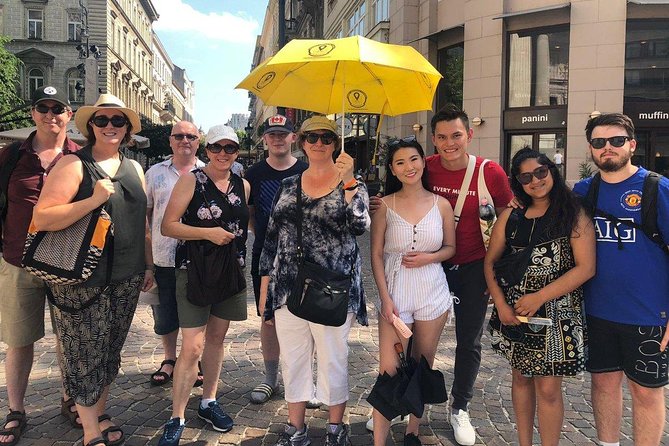
The tour meets near Kálvin tér 12-13 at OTP Bank Budapest, and guides are dressed in yellow. That small detail makes a huge difference on a busy city square, because you don’t waste time hunting for your group.
You finish near Széchenyi Lánchíd, the Chain Bridge area. From there, it’s easy to keep exploring on foot or hop to other parts of the city. Just know you end on the bridge side, not right back at your first stop, so plan your next meal or evening plan accordingly.
More of the city, bank to bank on foot:
- Budapest: Buda Castle Walk with Saint Stephen’s Hall
★ 4.5 · 3,012 reviews - Big Bus Budapest Hop-On Hop-Off Bus and Walking Tour
★ 3.5 · 2,206 reviews - Budapest: Buda Castle District Walking Tour
★ 4.6 · 2,108 reviews
Stop 1: Hungarian National Museum gardens and the turul bird
You begin in the garden area of the Hungarian National Museum, where you can see the statue of the mythical turul bird. This is a strong opening because it sets a tone: Budapest’s “big story” is not only WWII and Communism. It also includes older national myths and identity.
The guide also covers the museum’s collections and its founder, and then moves into 1948 and the uprising. Even without going inside, you get the historical framing that helps the rest of the tour click.
One practical consideration: this part is outdoors, so in rain or deep cold you’ll still be standing, listening, and regrouping with the group.
Stop 2: Kálvin Square and John Calvin’s footprint
At Kálvin tér, you meet the guide and learn about the square’s connection to French Protestant Reformer John Calvin. It’s a quick stop, but it gives you a useful way to read Budapest: names of squares are often clues to the city’s layers and influences.
The square also offers places to sit and shelter from the elements. That matters if you’re trying to keep your energy for the longer walk ahead.
Stop 3: Unger’s House and Miklós Ybl’s style-mixing design
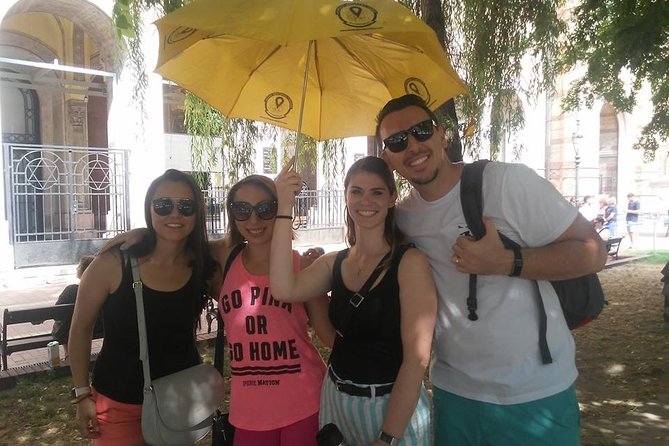
Next is Unger’s House, in the courtyard area of Miklós Ybl’s creation. This is one of those stops that feels like a visual puzzle. The building mixes several styles, including Byzantine, Gothic, Moorish, Renaissance, and Romantic elements.
Why I like this stop for first-timers: it trains your eye. You start noticing that Budapest’s architecture is not one uniform look. It’s a collection of eras and tastes layered on top of each other.
More centuries stacked along the banks:
- Budapest: Historic Cruise with Welcome Drink★ 4.7 · 6,512 reviews
- Buda Castle District Dark History, Legends and Vampire Night Tour★ 4.5 · 1,240 reviews
- BloodThirsty Hungary: Walking tour & Dark Historical Stories★ 4.9 · 633 reviews
Stop 4: Elizabeth Square, the Budapest Eye, and nightlife context

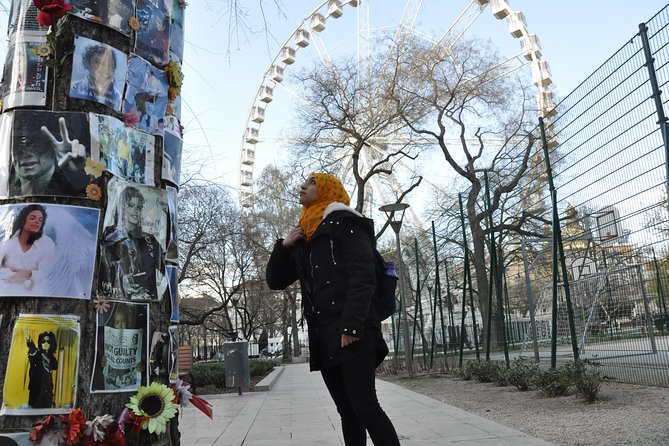
At Elizabeth Square, you’ll see the Budapest Eye and hear how this area developed. You’ll also get the location of some of Budapest’s cooler bars and nightlife zones.
This is more than “fun facts.” Knowing where nightlife concentrates helps you plan your evenings. It also gives you a sense of what locals do with public space today, which is the bridge between the tour’s historical theme and your real day-to-day experience.
Stop 5: Danubius Hotel Astoria and French Empire glamour
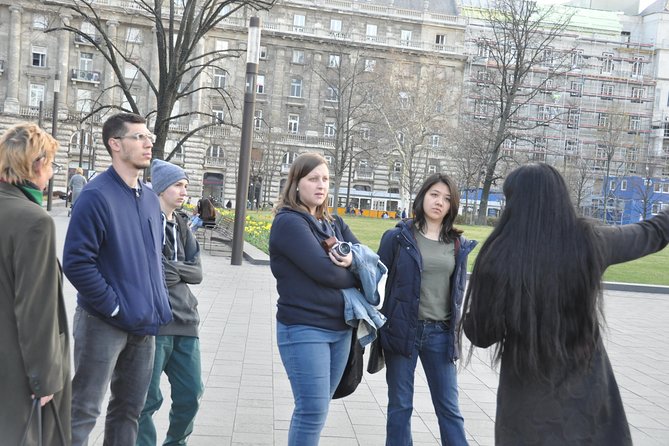
You pass the Danubius Hotel Astoria, an elegant building in French Empire style. The stop connects the city’s international vibe to pop culture history, including mention of the Josephine Baker story production directed by Brian Gibson, which gives Astoria a cinematic aura.
This is a great contrast after the more political stops. Budapest’s modern identity includes glamour, visitors, and global connections, not only heavy chapters.
The Jewish Quarter stretch: community, ghetto history, then creative life
The tour then travels through the Jewish Quarter, and the story is not one-note. You learn how the area shifted from home to a vibrant Jewish community, to a WWII ghetto, and later to a neighborhood that supports artists, students, and independent shops.
What makes this section useful is the way it ties past to present. Even if you walk through it later on your own, you’ll know what you’re seeing and why the neighborhood feels different block to block.
Stop 6: St. Stephen’s Basilica (Szent István Bazilika), named for Hungary’s first king
Outside St. Stephen’s Basilica, the tour focuses on why it is named for Hungary’s first king. The key word here is outside. You’re not relying on tickets during this portion, and that keeps the pace moving.
If you care about religious and national symbolism, this stop gives it a simple anchor so you can understand the “who” behind the monuments.
Stop 7: Liberty Square (Szabadság tér) and the Communist memorial
At Szabadság tér, you spend time at Liberty Square and see a Communist memorial. This is one of the tour’s most direct “politics-in-stone” moments.
A practical thought: these stops are emotionally heavier than the architecture ones. If you’re traveling with kids, you can still do the tour, but it may help to know that not every moment is light.
Stop 8: Stock Exchange Palace and what makes it special
You take in the Stock Exchange Palace. The scale is part of the attraction: the palace covers about 50,000 m² and is described as Budapest’s largest privately owned historic landmark.
This stop works if you like civic architecture and power buildings. It’s a reminder that economies, institutions, and politics shaped the city, not just monarchs or wars.
Stop 9: Ronald Reagan and the political art of statues
Next is the Ronald Reagan statue, and you also learn why Bush stands nearby waiting for him. It sounds almost playful, but it fits Budapest’s habit of turning political history into a visual statement you can walk up to.
If you’re the type who likes to read symbolism in public art, you’ll enjoy this.
Stop 10: Hungarian Parliament Building viewpoint and nearby institutions
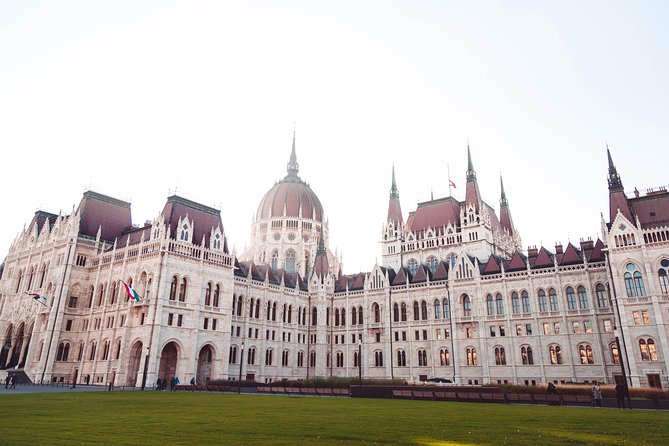
The tour stops outside the Hungarian Parliament Building for the outside look and the view over the Danube. You’ll also hear what to look for in terms of the building style described as electric or neo-gothic.
From this part of the square, you can also spot other named institutions, including the Chocolate Museum, the former ministry of Justice, and the agricultural museum. Even if you do not enter them on this tour, you now know what they are and why they’re clustered there.
Stop 11: Fisherman’s Bastion from the Pest side, St. Matthias, and St. Margaret area views
You’ll see the castle area and Fisherman’s Bastion from the Pest side, along with St. Matthias church and its colorful tiled roof. The guide also points toward the Hungarian National Palace from afar on the Pest side.
You’ll get wider context too, including St. Margaret’s Island and Gellért Hill views from across the river. I like this stop because it gives you a “big picture” sense of the city layout. If you later cross over to Buda, you’ll recognize the shapes you saw from Pest.
Stop 12: Széchenyi Lánchíd and the Chain Bridge reconstruction story
At Széchenyi Lánchíd, you learn the history of the chain bridge and its reconstruction. This is a small stop in time, but it’s the kind of bridge story that explains why Budapest’s river crossings matter so much.
The bridge is not just a photo. It’s part of how the city grew and how people moved.
Stop 13: Shoes on the Danube Bank, a simple memorial with heavy meaning
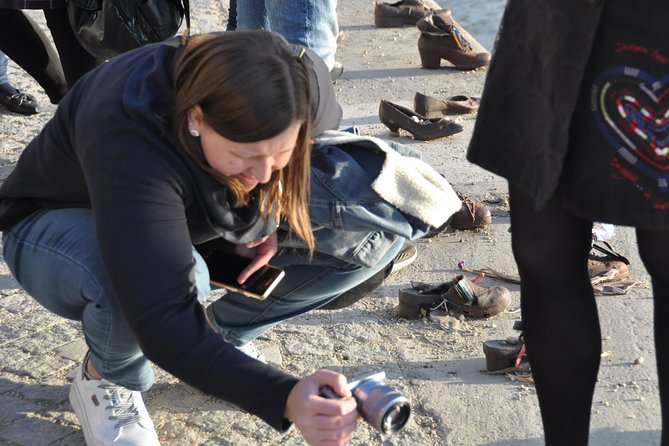
The final stretch highlights Shoes on the Danube Bank, a haunting monument of 60 pairs of shoes dedicated to Holocaust victims who were lined up and shot on the banks.
This is the emotional climax of the tour. The power here is the restraint. You don’t need speeches or crowds. You just face an image that’s painfully specific.
If you’re the kind of person who needs a moment to process, plan a few minutes after the tour to stand quietly before you rush into photos.
Pace, comfort, and what to bring when Budapest weather turns
This tour covers a lot of ground in about 2 hours 30 minutes. It’s doable for most people, but the operator notes it is not recommended if you cannot walk about 3 miles.
Budapest’s surface can be a challenge. Even when the route sounds short on paper, cobblestones and frequent stops mean your feet do the real work. Comfortable shoes are not optional.
Also bring what the cold season needs. The tour runs outside, and it can get seriously cold, including conditions like -9°C, with potential for much lower temperatures. Pack a warm jacket, and consider sunscreen too since winter light can still bite.
The tour includes a short break to buy drinks and use the toilet, but there is no coffee or food served.
Tickets, entry expectations, and what is actually included
Most stops are designed for outdoor viewing and guided explanation. You’ll see places like Parliament Building and St. Stephen’s Basilica from outside, so you’re not paying for entry at every stop.
That said, the tour does note that some admissions are not included, so if you want to go inside major sites, plan those separately on your own schedule. This tour is built more for orientation and context than for ticketed museum time.
Breaks, toilets, and why water helps
You’re encouraged to bring water to drink. It’s not only for comfort. When you’re standing and walking steadily for hours, it keeps you from getting shaky from cold air and wind.
Toilet access costs are your responsibility. A public toilet may be around 100 to 500 HUF, so if you want less stress, plan to have small change or whatever payment method you prefer for local facilities.
Guide quality and how to get the most from the route
The best part of the experience is the guide. Names show up often in guides you might be assigned, including Peter, Victoria, Elizabeth, Sabi, and George. Across those examples, the pattern is consistent: clear English, strong historical framing, and explanations that connect past to modern streets.
For you, the winning move is timing. Do this early in your trip so the route acts like a map for your next decisions. You’ll remember where things are and you’ll understand why certain areas feel the way they do today.
If you’re the kind of traveler with questions, this is a good tour to ask them. The guide’s job is to translate complicated periods into street-level stories you can actually use.
One more practical note: the guide cannot carry guest luggage or equipment. Keep your pack manageable so you’re not stuck adjusting your bag while moving.
Who this walking tour suits best
This is a great choice if:
- You want a fast overview of Budapest’s key landmarks on the Pest side
- You like history that shows up in monuments, square names, and building styles
- You’re traveling on a budget and you value local insight over ticketed attractions
It may be less ideal if:
- You cannot comfortably walk about 3 miles
- You prefer mostly indoor sightseeing
- You struggle with cold standing outdoors for short segments
Dogs are not permitted on the tour, but service animals are allowed with the usual expectations.
Should you book this Budapest Historical Sightseeing Free Walking Tour?
Yes, I’d book it if you want a smart first-day foundation. The minimal fee plus tips model makes it one of the most cost-effective ways to learn what matters in Budapest, and the route hits major viewpoints like Parliament and the Danube while also covering heavy, meaningful memorials like Shoes on the Danube Bank.
If you’re worried about weather or cobblestones, plan for cold protection and comfy shoes. If you want a smaller group experience or faster pacing with more personal Q&A, you might consider a private option, since group sizes can be up to 50.
Bottom line: if you go in ready to walk, listen, and look closely at squares and façades, this is the kind of tour that will make the rest of your Budapest days make sense.
The newest crossings added in Budapest






Historical Tours, compared.
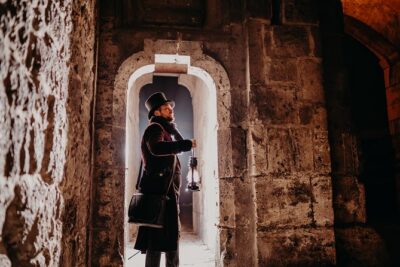
Buda Castle District Dark History, Legends and Vampire Night Tour
Read our review →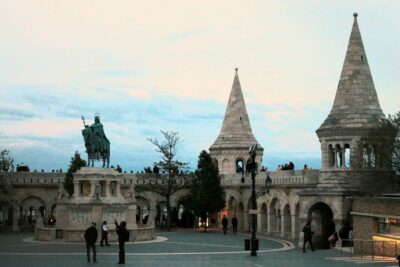
BloodThirsty Hungary: Walking tour & Dark Historical Stories
Read our review →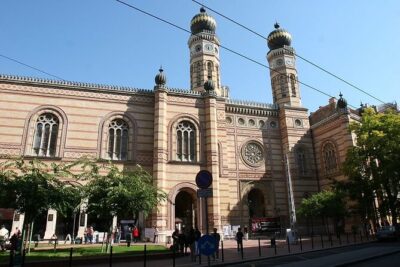
Budapest Jewish Heritage Memorial Walking Tour & Synagogue Entry
Read our review →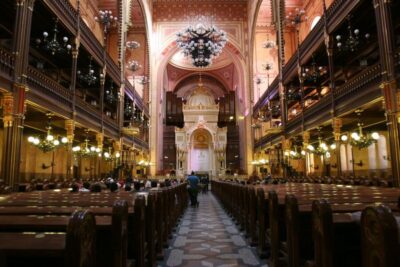
Jewish Heritage Guided Tour with Synagogue Ticket
Read our review →
Budapest Historic Downtown Bicycle Tour in small groups
Read our review →
Historic Downtown ride on E-Bicycles Buda & Pest
Read our review →
Jewish History Guided Walking Tour with Historian
Read our review →Browse the lists this tour appears in